
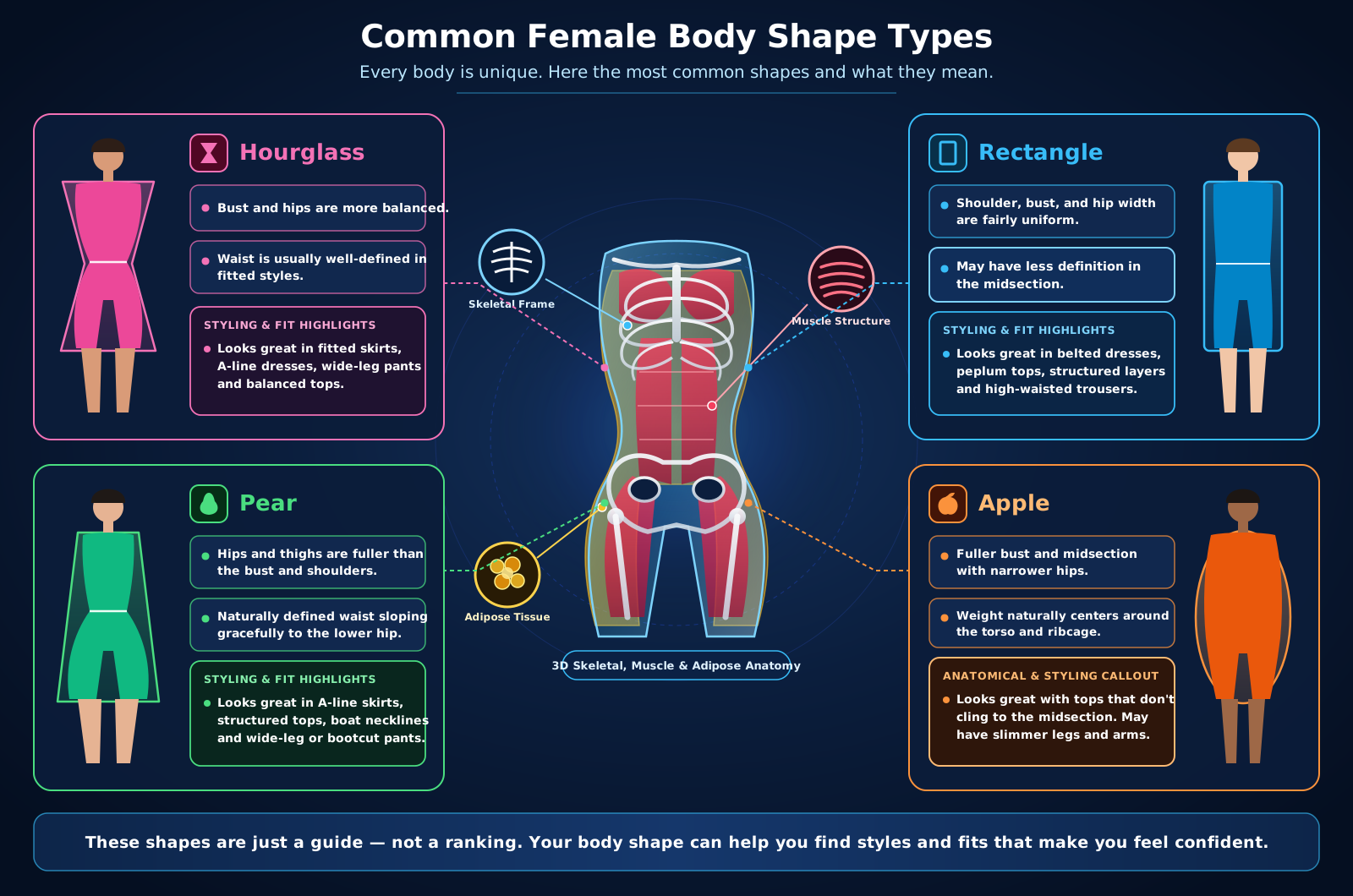
How to Measure Yourself for a Body Shape Types Calculator
A body shape types calculator is only as accurate as the numbers you feed into it. Even a one-inch slip of the tape measure can nudge your result from an Hourglass into a Rectangle or from a Pear into a Spoon.
Grab a soft fiberglass or cloth dressmaker's tape (not a stiff metal hardware tape), stand in front of a full-length mirror, and measure over form-fitting underwear or thin leggings. Keep your feet together and your shoulders relaxed.
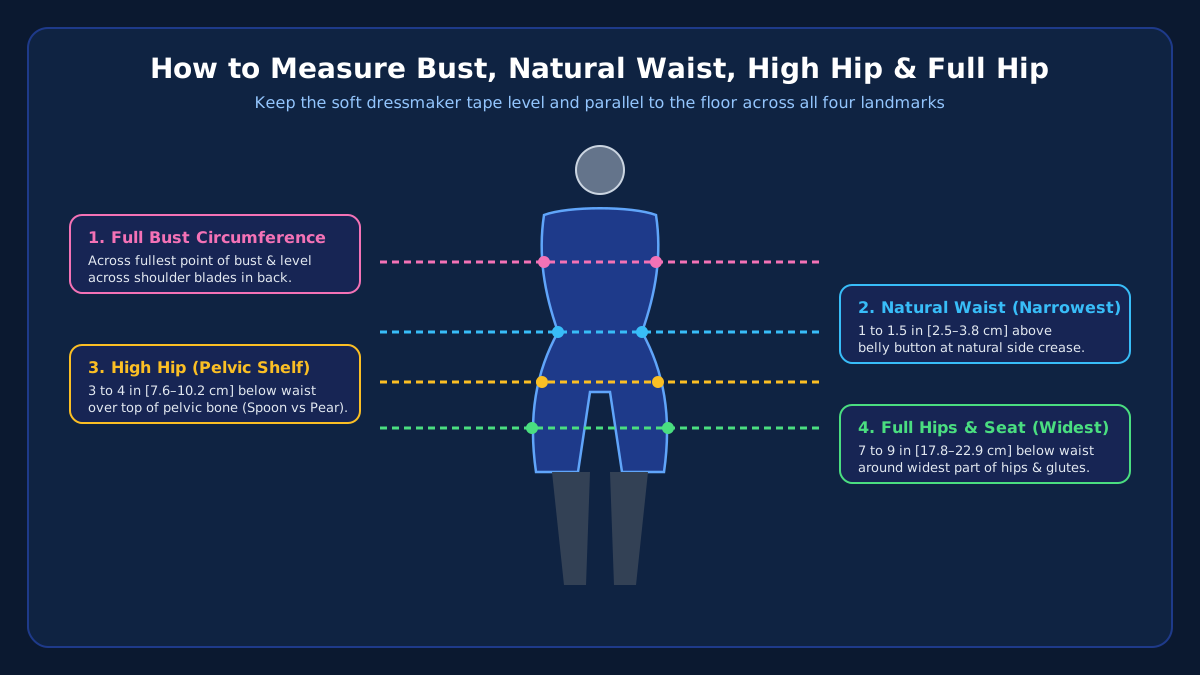
1. Full Bust (Inches [cm])
Wear an unpadded, everyday bra. Wrap the tape across the fullest point of your breasts and straight across your shoulder blades in the back. Keep the tape parallel to the floor so it doesn't droop under your arms.
2. Natural Waist (Inches [cm])
Bend gently to one side like a teapot—the crease that forms above your hip bone and below your lowest rib is your natural waist. It usually sits 1 to 1.5 inches [2.5 to 3.8 cm] above your belly button. Breathe out normally before reading the tape.
3. High Hip (Inches [cm])
Slide the tape down about 3 to 4 inches [7.6 to 10.2 cm] below your natural waist, right over the top pelvic bone shelf and the lower belly. This fourth number helps distinguish a gradual Pear curve from a sharper Spoon curve.
4. Full Hips & Seat (Inches [cm])
Stand with your heels together and wrap the tape around the widest part of your hips and glutes—usually 7 to 9 inches [17.8 to 22.9 cm] below your natural waist. Check the mirror sideways to make sure the tape stays level all the way around.
Five Common Measuring Mistakes That Skew Your Result
- 1. Measuring where your jeans sit instead of your natural waist: Most mid-rise jeans rest on the high hip, which is 2 to 4 inches [5.1 to 10.2 cm] wider than your true anatomical waist.
- 2. Sucking in your stomach or holding your breath: Pulling your ribs up shrinks your waist reading artificially and leads to buying waistbands that dig in the moment you sit down.
- 3. Wearing a push-up bra or thick sweatshirt: Padded cups or bulky hoodies easily add 1.5 to 2 inches [3.8 to 5.1 cm] to your bust and torso.
- 4. Pulling the tape tight enough to indent the skin: Keep one finger slipped flat beneath the tape so it hugs your contour without squeezing soft tissue.
- 5. Letting the back of the tape dip on your hips: If the tape slides under your glutes in the back, your hip measurement will read 1 to 2 inches [2.5 to 5.1 cm] smaller than it really is.
How a Body Types Calculator Classifies Your Proportions
Unlike a Body Mass Index (BMI) calculator that compares your weight to your height, a body types calculator looks strictly at circumference differentials—how your bust, waist, high hip, and full hip compare to one another. Two women who wear a US size 4 and a US size 18 can share the exact same Hourglass or Pear classification if their bust-to-waist-to-hip ratios match.
The mathematical rules used in modern apparel sizing come largely from the Female Figure Identification Technique (FFIT) developed at North Carolina State University by researchers Lee, Istook, Nam & Park (2007). Below are the exact inch (and centimeter) rules the algorithm checks.
| Body Shape Category | Bust vs. Hip Rule | Waist Definition Rule |
|---|---|---|
| Hourglass | (Bust − Hip) ≤ 1 in [2.5 cm] AND (Hip − Bust) < 3.6 in [9.1 cm] | (Bust − Waist) ≥ 9 in [22.9 cm] OR (Hip − Waist) ≥ 10 in [25.4 cm] |
| Bottom Hourglass | 3.6 in [9.1 cm] ≤ (Hip − Bust) < 10 in [25.4 cm] | (Hip − Waist) ≥ 9 in [22.9 cm] AND (High Hip ÷ Waist) < 1.193 |
| Top Hourglass | 1 in [2.5 cm] < (Bust − Hip) < 10 in [25.4 cm] | (Bust − Waist) ≥ 9 in [22.9 cm] |
| Spoon | (Hip − Bust) > 2 in [5.1 cm] | (Hip − Waist) ≥ 7 in [17.8 cm] AND (High Hip ÷ Waist) ≥ 1.193 |
| Pear (Triangle) | (Hip − Bust) ≥ 3.6 in [9.1 cm] (or > 2 in general) | (Hip − Waist) < 9 in [22.9 cm] |
| Inverted Triangle | (Bust − Hip) ≥ 3.6 in [9.1 cm] | (Bust − Waist) < 9 in [22.9 cm] |
| Rectangle | |Bust − Hip| < 3.6 in [9.1 cm] | (Bust − Waist) < 9 in [22.9 cm] AND (Hip − Waist) < 10 in [25.4 cm] |
| Apple (Oval) | Bust and Hips close; narrow lower hip | Waist ≥ Hip or Waist ≥ Bust, or WHR ≥ 0.86 with < 5 in [12.7 cm] waist drop |
What the SizeUSA 3D Body Scan Study Actually Found
You have probably seen websites claim that “only 8% of women are Hourglasses.” That number traces back to a 2004–2007 apparel study at North Carolina State University (Simmons, Istook & Devarajan; Lee et al., 2007) that analyzed over 6,000 three-dimensional body scans of U.S. women collected for the SizeUSA clothing project.
In that sample, roughly 46% of participants fell into the Rectangle category, just over 20% matched the Pear/Spoon category, nearly 14% matched the Inverted Triangle/Apple profile, and about 8% met the strict 9-to-10-inch waist-drop threshold for an Hourglass. Keep in mind that SizeUSA was designed to help clothing brands cut better patterns—not as a federal medical census—so percentages shift depending on age group and how strictly each formula draws the cutoff line.
What Each Female Body Shape Means for Fit & Everyday Styling
Great style isn't about trying to disguise your body or force every outfit to look like an hourglass. It's about understanding where off-the-rack clothes will naturally pull, gap, or drape on your frame so you spend less time frustrated in fitting rooms.
1. Hourglass (Balanced Bust & Hips, Defined Waist)
If your bust and hips sit within 1 to 2 inches [2.5 to 5.1 cm] of each other and your waist curves in by 8 to 10 inches [20.3 to 25.4 cm], standard straight-cut shirts and jeans often feel tight in two places and loose in the middle.
- • Tops: V-neck, scoop, and wrap tops that follow the ribcage without boxy seams.
- • Bottoms: Curvy-fit high-rise jeans and tailored wide-leg trousers.
- • Dresses: Belted shirt dresses, bias-cut midis, and fit-and-flare silhouettes.
2. Pear / Triangle & Spoon (Fuller Lower Half)
When your hips measure 3.6 inches [9.1 cm] or more wider than your bust, dresses and two-piece sets often fit on top while feeling snug across the seat—or fit the hips while swimming around the shoulders.
- • Tops: Boat necks, square necks, and structured blazers that frame the shoulders.
- • Bottoms: A-line skirts, wide-leg pants, and relaxed bootcut denim in dark washes.
- • Tailoring trick: Buy trousers to fit your full hip and have the waist darted in.
3. Apple / Oval & Inverted Triangle (Upper-Body Presence)
If your bust and shoulders lead your frame or you carry fullness through the midsection with narrower hips and leaner legs, rigid waistbands and high crew necks can make tops feel restrictive.
- • Tops: Open V-necks, collarless jackets, and empire or tunic cuts that skim cleanly.
- • Bottoms: Straight-leg jeans, flat-front pull-on trousers, and pleated wide-leg pants.
- • Fabrics: Structured cotton poplin, ponte, and linen blends that hold their own line.
4. Rectangle (Straight / Athletic Proportions)
When your bust, waist, and hips sit close in width, you have the easiest time buying off-the-rack trousers and slip dresses without waist gapping. You can play with volume on either half.
- • Tops: Peplum blouses, tucked-in knits, ruffled collars, and cropped jackets.
- • Bottoms: Pleated high-rise trousers, barrel-leg denim, and belted paperbag pants.
- • Dresses: Cut-out midis, wrap dresses, or sleek minimalist column silhouettes.
What to Do With Your Result (A 3-Step Closet Audit)
Knowing your shape from our body type calculator female tool doesn't mean throwing out your closet. Instead, use your numbers as a filter the next time you shop or get dressed:
- Check your five favorite outfits in your closet right now: Look at the rise of your favorite jeans (mid-rise vs. 11-inch [27.9 cm] high-rise) and the neckline of your most-worn tops. You will almost always see they already match your proportion profile.
- Shop by your largest horizontal measurement first: If you are a Pear or Spoon, check the hip column of the brand's size chart first. If you are an Apple or Inverted Triangle, check the bust and waist columns first. It is always easy for a tailor to take fabric in, but almost impossible to let a tight seam out.
- Save your four numbers in your phone notes: Online size charts vary wildly between brands, but actual garment measurements in inches and centimeters don't lie.
Body Type Calculator Male: How Men's Body Shapes Work
Searching for a body type calculator male guide? First, an honest note about the math: the interactive calculator at the top of this page is calibrated for adult female bust, waist, and hip ratios. Because men generally have narrower pelvises and broader clavicles, plugging male chest and hip numbers into a female formula will almost always misclassify a man as an Inverted Triangle or Rectangle.
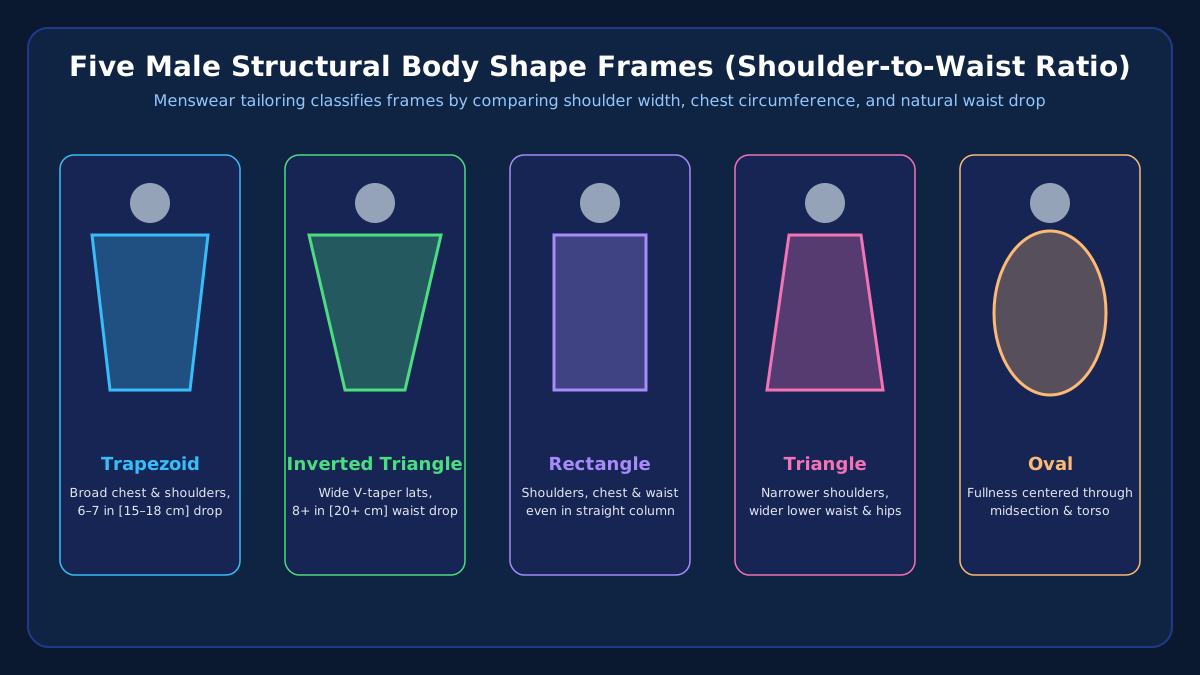
If you want to evaluate male tape measurements for fitness or military standards right now, you can check male and female tape measurements with our U.S. Army body fat calculator or calculate your lean muscle mass for strength and frame goals. In menswear tailoring, stylists compare shoulder circumference, chest, and waist across five structural frames:
1. Trapezoid (Athletic Drop)
Broad shoulders and chest that taper cleanly to a medium waist (typically a 6 to 7 in [15.2 to 17.8 cm] chest-to-waist “drop” in suit sizing). Most off-the-rack suits are cut for this frame.
2. Inverted Triangle (V-Taper)
Very wide shoulders and lats with a chest measurement 8+ inches [20.3+ cm] larger than the waist. Look for athletic-fit dress shirts with stretch and unstructured blazer shoulders.
3. Rectangle (Straight Frame)
Shoulders, chest, and waist measure nearly the same width. Structured sport coats, layered overshirts, and crew-neck sweaters add chest and shoulder dimension.
4. Triangle (Lower-Mid Frame)
Narrower sloping shoulders with a wider waist and hip line. Single-breasted jackets with lightly padded shoulders and straight-leg trousers balance the upper torso.
5. Oval (Round Midsection)
Fullness concentrated around the center of the torso with narrower shoulders and legs. Vertical pinstripes, dark monochrome layers, and V-neck sweaters lengthen the torso.
What About Ectomorph, Mesomorph, and Endomorph Somatotypes?
In gyms, you will also hear people talk about somatotypes—ectomorph (lean, narrow bone structure), mesomorph (naturally muscular, medium frame), and endomorph (broader frame that stores both muscle and fat easily). Keep in mind that somatotypes were originally proposed in the 1940s by psychologist William Sheldon and are considered a popular but loosely scientific shorthand rather than a strict medical diagnosis. Most people are a blend of traits (such as ecto-mesomorph) and can change their body composition through nutrition and training.
Waist-to-Hip Ratio (WHR) vs. Body Shape: What the Science Really Says
While your overall silhouette (Pear, Hourglass, Rectangle, Apple) is a styling tool, your waist-to-hip ratio (WHR)—calculated as Waist ÷ Hips—is sometimes used by researchers to study where the body stores fat. You can also run a dedicated waist-to-hip ratio calculation or estimate your body composition with the U.S. Navy body fat calculator for a fuller picture.
Because a lot of exaggerated claims circulate online about WHR, let's look at what major health agencies and peer-reviewed studies actually say:
1. WHO Waist-to-Hip Ratio Cutoffs Measure Abdominal Obesity—Not BMI Obesity
Some articles claim that a WHR above 0.85 in women or 0.90 in men “equals a BMI over 30.” That is inaccurate. According to the World Health Organization (WHO) Expert Consultation on Waist Circumference and Waist–Hip Ratio, a WHR above 0.85 for women (and above 0.90 for men) is the threshold for abdominal (central) obesity, meaning a higher concentration of visceral fat around the abdominal organs. A person can have a normal BMI under 25 and still have an elevated WHR, or have a BMI over 30 with a lower WHR. You can also explore healthy weight ranges by height in our ideal weight calculator.
2. NIDDK / NIH Guidance on Waist Circumference & Visceral Fat
According to the National Institute of Diabetes and Digestive and Kidney Diseases (NIDDK / NIH), carrying excess fat around the midsection (an “apple-like” central distribution, especially a waist measurement over 35 inches [88.9 cm] for non-pregnant women or 40 inches [101.6 cm] for men) is linked to a higher risk of type 2 diabetes, high blood pressure, and heart disease than carrying weight on the hips and thighs.
3. The 2005 INTERHEART Study (Yusuf et al., The Lancet)
In the landmark INTERHEART case-control study by Yusuf et al. (The Lancet, 2005) involving 27,098 participants across 52 countries, researchers found that waist-to-hip ratio showed a stronger, graded association with heart attack (myocardial infarction) risk than BMI alone. Participants in the highest fifth of waist-to-hip ratio had an odds ratio of 2.52 for myocardial infarction compared with the lowest fifth—showing that central fat distribution matters clinically, though internet summaries that turn this into “apple shapes are three times more likely to die of a heart attack” overstate the finding.
4. Putting Fertility & WHR Claims in Context
Older observational research—such as a 1993 BMJ cohort study of 500 women attending an artificial-insemination clinic (Zaadstra et al.)—reported higher conception probability among women with a WHR below 0.80 compared with those above 0.80. However, reproductive endocrinologists emphasize that a tape measure cannot diagnose fertility: hormone levels, ovulation regularity, age, and conditions like PCOS drive fertility outcomes, and healthy pregnancies happen across every body shape.
Frequently Asked Questions About Body Shape Calculators
1. How do I calculate my female body type at home?
Wrap a soft tape measure around the fullest part of your bust, the narrowest part of your natural waist, and the widest point of your hips and seat. Enter those three numbers (plus optional high hip) into our body type calculator female tool in inches or centimeters to compare your bust-to-hip and waist ratios.
2. What is the most common female body shape in the United States?
According to a 2004–2007 North Carolina State University apparel study of over 6,000 U.S. women using 3D SizeUSA scans, the Rectangle (straight) shape was the most common at roughly 46%. About 20% were Pear (spoon/triangle), nearly 14% were Inverted Triangle or Oval, and about 8% matched the strict Hourglass cutoff.
3. Can my body shape change with weight loss or strength training?
Your underlying bone structure—such as collarbone width, ribcage size, and pelvic width—stays fixed in adulthood. However, building glute, back, or shoulder muscle through resistance training or losing visceral belly fat can change your bust, waist, and hip circumferences enough to shift you between adjacent categories like Rectangle and Hourglass.
4. What is the difference between Pear and Spoon body shapes?
Both Pear (triangle) and Spoon shapes have hips that measure wider than the bust. The difference lies in how the curve starts below the waist: a Pear shape slopes outward gradually through the lower hip and thigh, whereas a Spoon shape curves out sharply right at the high hip bone.
5. Does waist-to-hip ratio determine my body shape or my health?
Waist-to-hip ratio (WHR) divides your waist circumference by your hip circumference. Clinicians and the World Health Organization use WHR to screen for abdominal fat distribution (above 0.85 in women or 0.90 in men). By contrast, a clothing body shape calculator compares bust, waist, and hips together for wardrobe fit.
6. Can men use this female body type calculator?
No. The formulas in this tool are calibrated for adult female bust, waist, and hip proportions. Men typically evaluate frame shape by comparing shoulder width, chest, and waist measurements across five male silhouettes: Trapezoid, Inverted Triangle, Rectangle, Triangle, and Oval. See our dedicated male body type section above for details.
Editorial Verification & On-Page SEO Specifications (Title, Meta, Links & Image Alt Reference)▼
/body-type-calculator-female
Crawlable Image URLs, Dimensions & Accessible ALT Text Specifications (Primary Keyword Used in Only 1 ALT)
| Crawlable Image URL | Dimensions & Loading | ALT Text |
|---|---|---|
| /images/common-female-body-shape-types-infographic.svg | 1600×1060 · fetchpriority="high" (no lazy load) | Common female body shape types infographic showing 3D skeletal, muscle, and adipose anatomy alongside Hourglass, Pear, Rectangle, and Apple silhouettes for our body type calculator female guide. |
| /images/how-to-measure-female-body-type-bust-waist-hips.svg | 1200×675 · loading="lazy" decoding="async" | Diagram showing where to place a soft tape measure at the full bust, natural waist, high hip, and full hip in inches and centimeters. |
| /images/male-body-shape-frames-comparison-chart.svg | 1200×675 · loading="lazy" decoding="async" | Five male body shape frames—Trapezoid, Inverted Triangle, Rectangle, Triangle, and Oval—based on shoulder-to-waist proportions. |